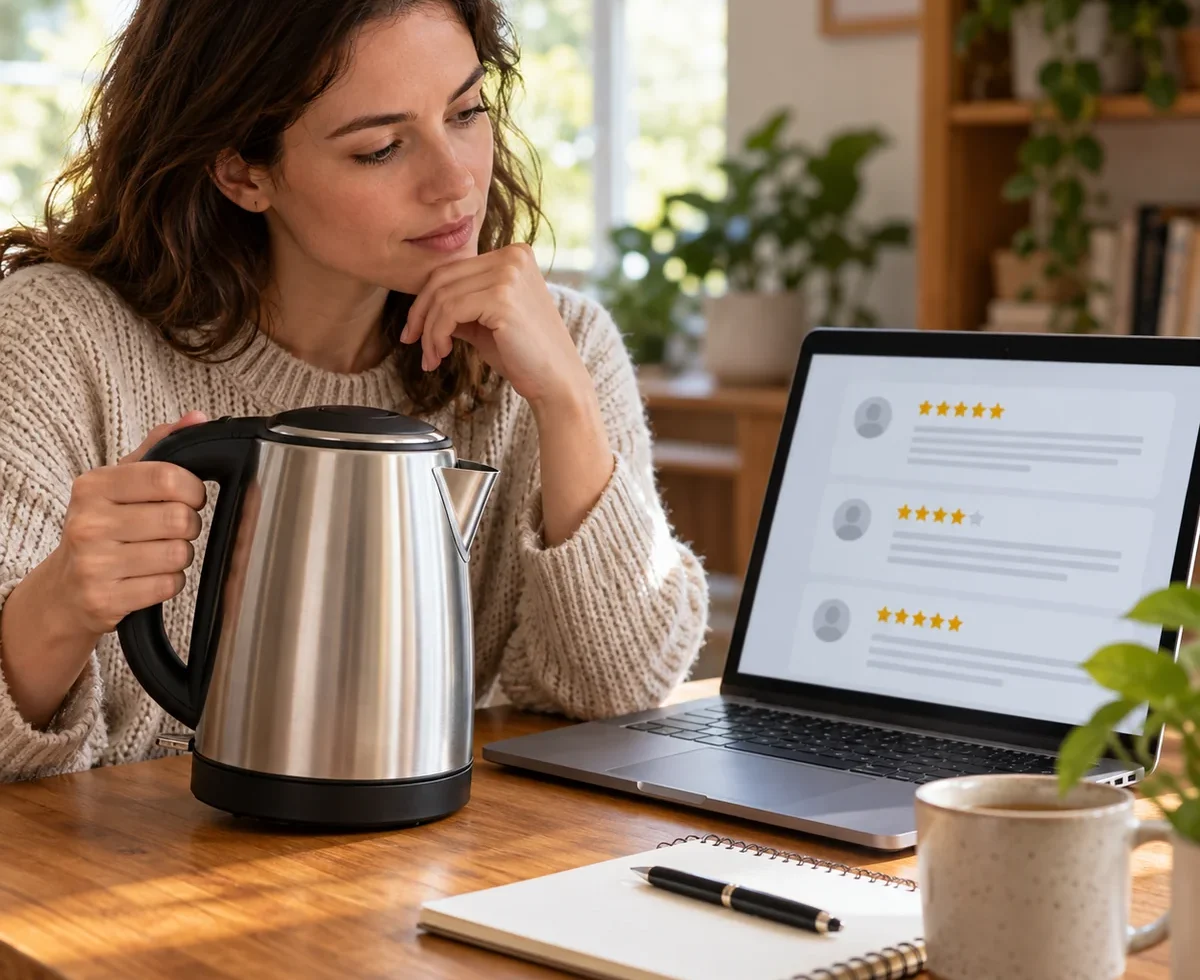
A product can have thousands of glowing ratings and still be wrong for your home. The average score hides the details you actually need: whether it fits, lasts, works as described, and can be returned if it does not. A useful review check begins with your own requirements, then looks for patterns across several sources.
The quick answer: Write down the one or two jobs the product must do. Confirm the exact model and dimensions. Read recent, detailed reviews across more than one site; look for repeated problems that matter to you, not a single dramatic complaint. Check the seller, total cost, and return terms before paying. If the evidence is thin or contradictory, wait or choose another product.
Decide what would make the purchase worthwhile
Before opening the review section, name the job. For a kettle, that could be fitting beneath a cabinet, pouring without drips, and having a handle that feels comfortable. For storage containers, it might be a lid you can replace and a shape that fits your shelf. A five-star rating cannot tell you which details matter in your kitchen.
Measure the available space and note any non-negotiable features. Also check whether something you already own can do the job. This short pause keeps you from spending an hour comparing reviews for an item you do not need. If the urge to buy arrived through an ad or countdown timer, our guide to stopping impulse buys online offers a useful pause before checkout.

Match reviews to the exact product
Check the brand, model number, size, material, and version shown on the listing. Marketplace pages sometimes combine colors, sizes, or related models in one review section. A complaint about a different capacity or an older design may not apply to the item in your cart. Read the review’s variant information where the site provides it.
Look at the product description and manufacturer specifications alongside the reviews. If the two disagree on an important dimension or feature, ask the seller to clarify before buying. The U.S. Federal Trade Commission recommends noting model numbers and details such as size when comparison shopping.

Read for repeated experiences, not a magic star score
Scan a mix of high, middle, and low ratings. Detailed middle-range reviews can describe a real trade-off: a product works well but is larger, louder, or harder to clean than expected. A single negative review is a clue, not a verdict. Several independent reviewers describing the same failure after similar use deserve closer attention, especially when it concerns your must-have feature.
Check dates. A cluster of reviews in a short period, or old praise followed by recent complaints, is worth investigating. Read reviewer history when available, and notice whether an incentive or free product is disclosed. The FTC cautions that you usually cannot identify every fake review by appearance alone; deceptive reviews can be positive or negative and may use less than a perfect score.

Leave the product page and check another source
Search for the exact model on a second retailer, a reputable independent review site, or a relevant owner forum. Compare what people say after longer use, not only on delivery day. When a review site ranks products, look for an explanation of its testing method and whether a ranking is sponsored. The FTC recommends using a variety of sources rather than relying on a single star rating.
Search the seller’s name separately if it is unfamiliar. Reviews of the product and reviews of the seller answer different questions: the product may be sound while delivery, support, or returns are poor. If you are choosing between a repair and a new item, use our repair-or-replace guide before ordering.
Check the costs and return path before paying
Confirm the price after shipping, fees, and any required extras. Read the return window, who pays return shipping, whether a restocking fee applies, and whether sale or marketplace items have different terms. A generous review score is much less useful if the product is hard to return when it does not fit.
On a marketplace, identify the actual seller and whether the platform will help with a dispute. The FTC’s marketplace advice says protections vary by site and may have short claim windows. Keep a copy of the listing, order confirmation, and return terms. For a separate check on promotional pricing, see how to tell whether a sale is a good deal.

Make a decision you can explain in one sentence
Choose the product if it meets your requirements, the concerns in reviews are acceptable, and the full cost and return terms work for you. Skip it if the main benefit is only a high rating or a temporary discount. If reviews disagree, identify the uncertainty: perhaps you need the exact measurements, a longer-use report, or a clearer warranty. You can then look for that answer instead of scrolling indefinitely.
A useful final question is: “Would I still want this at this price if nobody had given it stars?” That separates the purchase from the rating. If the answer is no, close the tab and return when you have a real use for it.

Common questions
Are verified-purchase reviews always trustworthy?
A purchase label is useful context, not proof that the account is independent, the review is unbiased, or the product suits you. Read its details and compare with other sources.
Should I ignore one-star reviews?
No. Read enough to learn what failed and whether the complaint applies to the exact model and your use. Do not let one extreme account outweigh a broader, consistent pattern without a reason.
Is a recent burst of five-star reviews proof of manipulation?
No. It is a signal to investigate, not a diagnosis. A launch or promotion can also create a burst. Check review details, dates, other sources, and the seller.
What if a product has almost no reviews?
Look for independent testing, manufacturer specifications, a clear warranty, and a return policy you can use. If the purchase is expensive or difficult to return, waiting for better evidence may be sensible.
Sources
- U.S. Federal Trade Commission: How To Evaluate Online Reviews — varied sources, dates, reviewer history, and limits of spotting deceptive reviews.
- U.S. Federal Trade Commission: Online Shopping — comparison shopping, full cost, returns, and purchase records.
- U.S. Federal Trade Commission: Buying From an Online Marketplace — seller checks and marketplace protections.