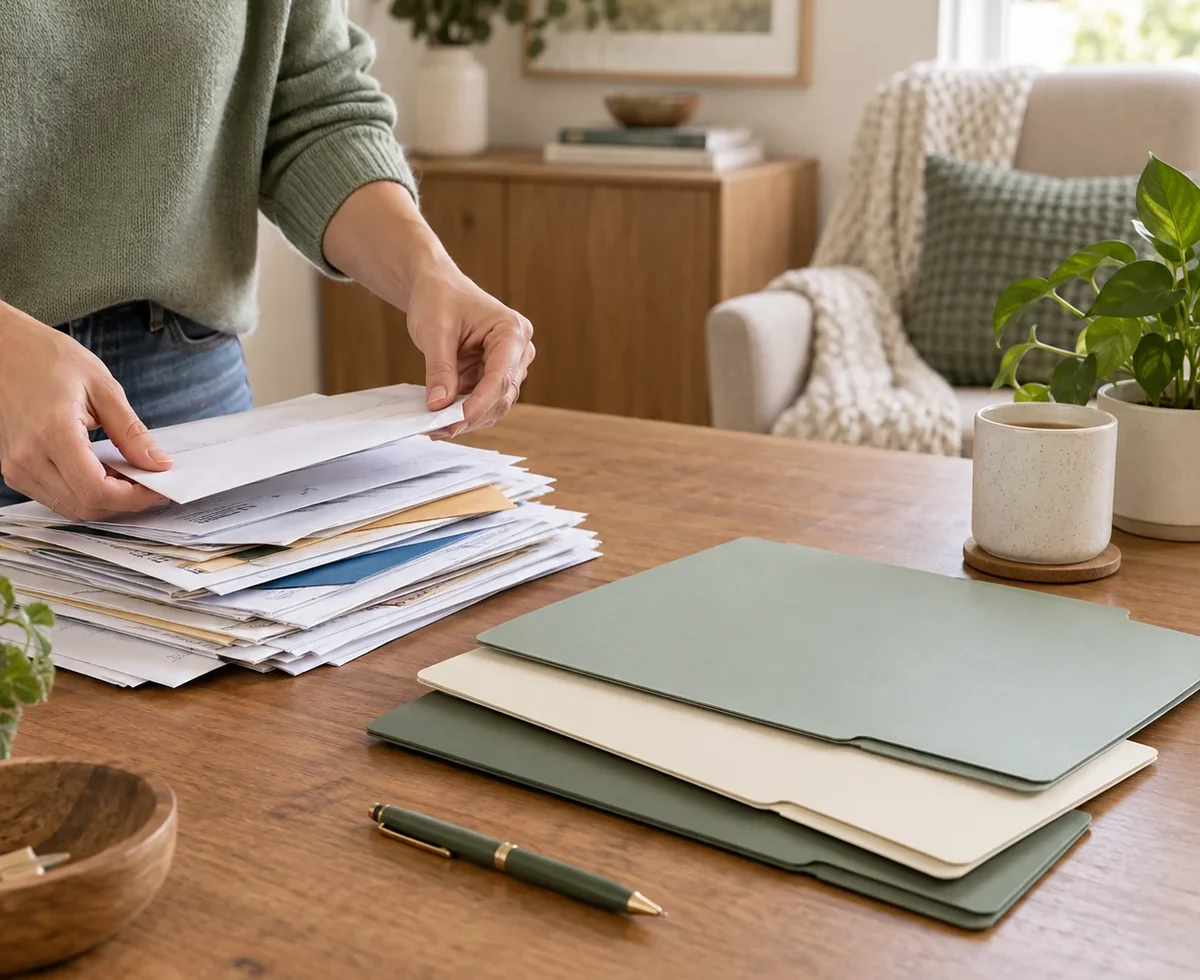
Paper clutter is difficult because the next decision is not always obvious. A supermarket flyer can leave today; a bill may need action; a signed agreement may matter years from now. When all three land in one pile, clearing the counter can feel risky. You do not need to sort every record in your home at once. Start with one stack and give each sheet a clear next destination.
This guide creates a simple paper flow using folders and containers you already own. It is for household mail and records, not a legal retention schedule. Requirements for tax, medical, property, employment, and business records depend on the document and where you live. If a record might have legal or financial value, check the relevant agency or a qualified professional before disposing of it.
Start with one visible pile
Choose the kitchen counter, entry table, or the top of a desk. Gather only the papers from that spot into one tray or shallow box. Do not empty every filing cabinet or open old family archives as part of a quick reset. Set aside ten or fifteen minutes to make first-pass decisions, and stop at a sensible point if you reach an unfamiliar document.

Keep the papers face down or away from a camera if they contain names, addresses, account numbers, or medical information. A tidy photo is not worth exposing private details. Have a pen, a calendar, one folder for records, and a secure place for sensitive disposal nearby.
Give each paper one of four routes
Read just enough to decide its next action. Use four routes: Act for something that needs a reply or payment; Keep for a record you have a reason to retain; Verify for anything whose retention or authenticity is uncertain; and Discard securely for material you do not need. Plain, nonsensitive paper can go to your local recycling stream if accepted. Sensitive paper needs a safer disposal step.

Do not make a large “keep just in case” stack without a later review date. Write a short note on an envelope or sticky tab describing what must be verified, such as “check warranty terms” or “ask tax preparer.” Put that note on your calendar. Uncertainty is a task, not a storage category forever.
Move action papers into a visible system
Put bills, forms, invitations requiring a reply, and other live tasks in one shallow tray or folder. Record the due date and next step in a calendar you actually use. If you have completed a task, move its record to the right keep location or dispose of it only after checking whether it must be retained. Do not hide pending papers in a closed archive box.

A weekly five-minute review is more reliable than repeatedly reorganizing a growing pile. Check the tray, finish a small action, and notice anything nearing its due date. If several people share the household, agree who handles each paper so it does not become everyone’s assumed responsibility and nobody’s actual task.
Protect documents you truly need to keep
The U.S. Federal Trade Commission distinguishes between short-term records, records kept while you own something, and vital documents kept long term. Its examples include vehicle titles, home deeds, and warranty information for major appliances. The details may differ for your situation; use the agency’s guidance and the relevant issuer’s requirements before setting a destruction date. Keep an original if a process may require it.
Give important documents a consistent, secure location. A labeled folder can hold routine records; vital originals may need stronger protection. FEMA recommends considering a fire-resistant, water-resistant box or safe for critical paper records and protected electronic copies. If you make digital copies, store them behind a strong password and verify that a copy opens before relying on it. A scan does not automatically replace an original.

Use broad folder names that match how you will look for a document: Home, Vehicle, Health, Tax, and Warranties, for example. Avoid a complex filing system that requires a new product for every sheet. Review the folder when a policy expires, an item is sold, or a record changes; check the appropriate retention rules before discarding anything.
Dispose of personal information securely
The FTC advises shredding documents with personal or financial information when it is time to dispose of them. If you do not have a shredder, look for a local community shredding event or another secure service. Do not place intact account statements, credit offers, medical details, or identification copies into an open recycling bin. Confirm how a service handles material before leaving papers with it.
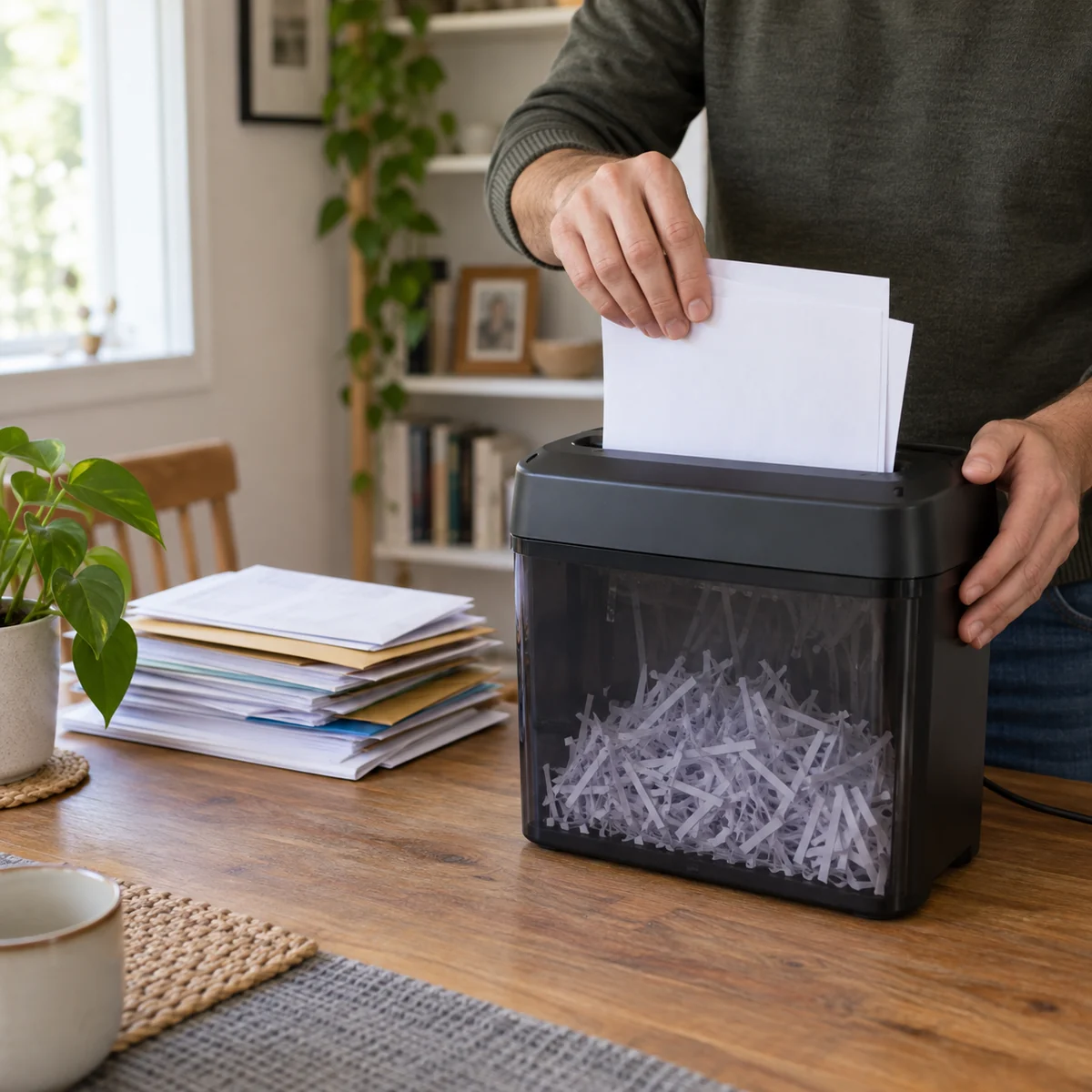
For nonsensitive mail, the U.S. Environmental Protection Agency says many community programs accept ordinary paper and even window envelopes. Acceptance of shredded paper varies by local program, so check the rules before putting it in the bin. Recycling is the last step in the paper flow; reducing unwanted paper arriving at home can prevent the next pile.
Stop the pile from returning
- Open mail near the four-route station rather than carrying it from room to room.
- Put a due date in your calendar as soon as a paper needs action.
- File a true keep record in its secure location, not in the action tray.
- Put uncertain documents in one small review folder with a date to verify them.
- Ask senders how to reduce unwanted catalogs or switch suitable communications to electronic delivery when it works for you.
The goal is not a paper-free home. It is a home where important records can be found, live tasks are seen, and unwanted paper does not get a permanent place. If the surrounding room needs a broader reset, use our guide to decluttering without throwing everything away after this one paper station works.
Common questions
Should I scan everything and throw away the originals?
No. First check whether an original is needed for identification, property, legal, tax, or other purposes. Make secure copies of critical records where useful, but do not assume a scan is an accepted substitute.
How long should I keep a bill or tax record?
That depends on the document, your circumstances, and applicable rules. The FTC offers U.S. examples, and the issuing agency or your qualified adviser can help with a specific record. Avoid applying a single household-wide deadline.
Can shredded paper go in my recycling bin?
Sometimes. The EPA says acceptance varies by local recycling program. Check your municipality’s current rules or the shredding service’s process.
Sources
- U.S. Federal Trade Commission, Protecting your personal information: Which documents to keep and which to shred.
- FEMA, Safeguard Critical Documents and Valuables.
- U.S. Environmental Protection Agency, How Do I Recycle Common Recyclables?